Reordering and Reorienting One Assembly to Match Another
A freshly assembled genome rarely comes out tidy: contigs are emitted in an arbitrary order, and roughly half of them are written on the opposite strand to the reference you want to compare against. The resulting dotplot is a mess of off-diagonal blocks and anti-diagonal (reverse-strand) lines that is hard to interpret.
This tutorial walks through cleaning that up with CrossIndex:
- Load a reference and a scrambled draft assembly into one
CrossIndex(one group each). - Compute cross-group k-mer matches and plot the messy baseline dotplot.
- Call
reorder_for_colinearity('draft', 'ref', reorder_target=False)to sort the draft contigs along the reference and detect reverse-oriented ones. - Re-plot with
reverse_contigs=to see the clean, near-diagonal layout. - Export the corrected draft as a FASTA file with
write_fasta— contigs written in the new order, with reversed contigs reverse-complemented.
Orientation is relative. A contig is only "reversed" with respect to a reference. Here the reference (
'ref'group) is the fixed forward frame: its contigs never move or flip; only the draft is reordered and reoriented.
1. Build two toy assemblies
The reference has three chromosomes of random (non-repetitive) DNA. The draft contains the same sequence content, but scrambled the way a real assembler might leave it:
chr1is split into two contigs, and the second piece is reverse-complemented;chr2comes back as a single reverse-complemented contig;chr3is intact and forward;- the contig names (
tig...) carry no hint of where anything belongs.
import random
import tempfile
from pathlib import Path

from dot_explorer.paf_io import CrossIndex, reverse_complement


def random_dna(length, seed):
    rng = random.Random(seed)
    return ''.join(rng.choice('ACGT') for _ in range(length))


# Reference assembly: three chromosomes.
chr1 = random_dna(500, seed=11)
chr2 = random_dna(400, seed=22)
chr3 = random_dna(300, seed=33)

reference = {'chr1': chr1, 'chr2': chr2, 'chr3': chr3}

# Draft assembly: same content, shuffled and partly reverse-oriented.
draft = {
    'tig1': chr3,                            # chr3, forward
    'tig2': reverse_complement(chr1[250:]),  # second half of chr1, REVERSED
    'tig3': reverse_complement(chr2),        # chr2, REVERSED
    'tig4': chr1[:250],                      # first half of chr1, forward
}

print('Reference order:', list(reference))
print('Draft order    :', list(draft))
Reference order: ['chr1', 'chr2', 'chr3']
Draft order    : ['tig1', 'tig2', 'tig3', 'tig4']
2. Load both assemblies into a CrossIndex
Each assembly goes into its own group ('ref' and 'draft'). With real data
you would call cross.load_fasta('reference.fasta', group='ref') and
cross.load_fasta('draft.fasta', group='draft') instead of add_sequence.
cross = CrossIndex(k=13)

for name, seq in reference.items():
    cross.add_sequence(name, seq, group='ref')

for name, seq in draft.items():
    cross.add_sequence(name, seq, group='draft')

print(cross)
CrossIndex (k=13)
  Total sequences : 7
  Group 'ref'       :      3 sequences
  Group 'draft'     :      4 sequences
  Computed pairs  : none (call compute_matches() first)
  PAF records     : 0
3. Compute matches and plot the messy baseline
compute_matches() is the explicit step that computes and caches cross-group
k-mer matches — it is required before reordering. We compute the
('draft', 'ref') pair: the draft is the query (rows) and the reference is
the target (columns), i.e. the reference is the fixed frame the draft will
be aligned to.
The baseline many-vs-many dotplot shows the problem: matches are scattered
across off-diagonal panels, and the reverse-oriented contigs (tig2, tig3)
appear as red anti-diagonal lines.
Plotting note. With
query_group=/target_group=,DotPlotterrenders directly from the stranded matches cached bycompute_matches()— forward matches in blue, reverse-strand matches in red — with each group's rows and columns following its currentcontig_order.
from dot_explorer.dotplot import DotPlotter

cross.compute_matches(query_group='draft', target_group='ref')
print('Computed group pairs:', cross.computed_group_pairs)

plotter = DotPlotter(cross)

fig = plotter.plot(
    query_group='draft',
    target_group='ref',
    figsize_per_panel=1.8,
    scale_sequences=True,
    title='Baseline — draft vs reference (as assembled)',
    dpi=80,
)
Computed group pairs: [('draft', 'ref')]
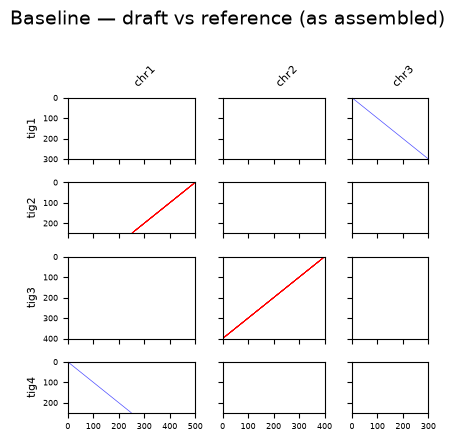
Reading this grid: tig4 and tig2 both hit chr1 (tig4 forward in blue,
tig2 as a red reverse-strand anti-diagonal), tig3 hits chr2 on the
reverse strand (red), and tig1 hits chr3 forward — but nothing lines up
along the main diagonal of the grid.
4. Reorder and reorient the draft against the reference
reorder_for_colinearity(query_group, target_group, reorder_target=False) uses
the d-genies gravity algorithm: each draft contig is assigned to its
best-matching reference chromosome, ordered by its gravity centre there, and
flagged if it aligns predominantly on the reverse strand.
Passing reorder_target=False keeps the reference group's order fixed —
exactly what you want when aligning a draft to an established reference. The
new order is stored in contig_order and the flagged contigs are available via
reversed_contigs('draft').
cross.reorder_for_colinearity('draft', 'ref', reorder_target=False)

print('Reference order (unchanged):', cross.contig_order['ref'])
print('Draft order (optimised)    :', cross.contig_order['draft'])
print('Draft reverse-oriented     :', sorted(cross.reversed_contigs('draft')))
Reference order (unchanged): ['chr1', 'chr2', 'chr3']
Draft order (optimised)    : ['tig4', 'tig2', 'tig3', 'tig1']
Draft reverse-oriented     : ['tig2', 'tig3']
The draft now mirrors the reference: the two chr1 pieces come first (tig4
then tig2, matching their positions along chr1), followed by the chr2
contig (tig3) and the chr3 contig (tig1). tig2 and tig3 are
correctly detected as reverse-oriented.
5. Re-plot: the clean, near-diagonal picture
Groups are plotted in their current contig_order, so the draft rows follow
the optimised order automatically. Passing the detected set as
reverse_contigs= renders those contigs reverse-complemented, so their matches
read along the main diagonal (in blue) instead of the red anti-diagonal.
The underlying coordinates are never modified — only the rendering.
fig = plotter.plot(
    query_group='draft',
    target_group='ref',
    figsize_per_panel=1.8,
    scale_sequences=True,
    title='After reorder_for_colinearity — draft matches the reference',
    dpi=80,
    reverse_contigs=cross.reversed_contigs('draft'),
)
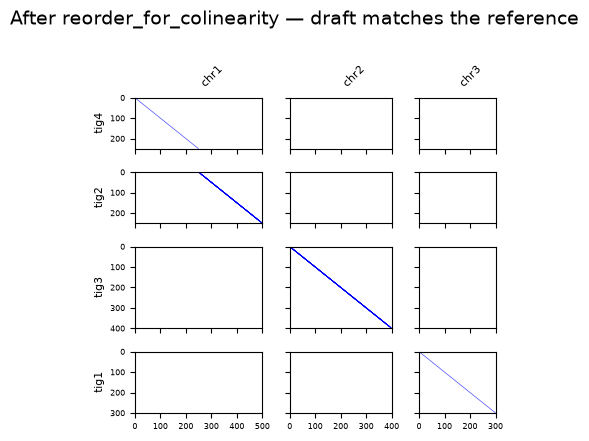
All matches now sit on the main diagonal of the grid, and the previously red anti-diagonal lines are rendered forward (blue): the draft reads like the reference, top-left to bottom-right.
6. Export the corrected draft as FASTA
write_fasta(path, group) persists this layout: contigs are written in the
group's current contig_order, and every contig in reversed_contigs(group) is
reverse-complemented so it reads forward. Flipped records carry a
reverse_complement note in their header.
outdir = Path(tempfile.mkdtemp())
out_fasta = outdir / 'draft_corrected.fasta'

cross.write_fasta(out_fasta, group='draft')

print('--- draft_corrected.fasta headers (in file order) ---')
for line in out_fasta.read_text().splitlines():
    if line.startswith('>'):
        print(line)
--- draft_corrected.fasta headers (in file order) ---
>tig4
>tig2 reverse_complement
>tig3 reverse_complement
>tig1
The headers confirm the new contig order, and tig2 / tig3 are marked as
reverse-complemented. A quick check that the flipped sequences now equal the
forward reference:
written = {}
for block in out_fasta.read_text().split('>'):
    if not block.strip():
        continue
    header, *seq_lines = block.splitlines()
    written[header.split()[0]] = ''.join(seq_lines)

assert written['tig2'] == chr1[250:]  # flipped back to forward chr1 second half
assert written['tig3'] == chr2        # flipped back to forward chr2
assert written['tig4'] == chr1[:250]  # untouched
assert written['tig1'] == chr3        # untouched
print('All draft contigs now read in the forward reference orientation.')
All draft contigs now read in the forward reference orientation.
Summary
- Load two assemblies into one
CrossIndex(groups'ref'and'draft'), thencompute_matches()for the pair. reorder_for_colinearity('draft', 'ref', reorder_target=False)sorts the draft along the fixed reference and flags reverse-oriented contigs (reversed_contigs('draft')).DotPlotter.plot(..., reverse_contigs=...)renders the flagged contigs flipped, turning the messy baseline into a near-diagonal plot.write_fasta(path, group='draft')exports the corrected assembly: reordered, with reversed contigs reverse-complemented.
Related tutorials
- All-vs-All Between Two Indices — the
CrossIndex/compute_matchesworkflow in more depth. - Writing Reordered FASTA — more
write_fastascenarios, including reordering both assemblies at once. - PAF Workflow — working with PAF records directly.